
For most of my career, I’ve heard the same challenge from leadership teams.
We need to move faster.
Today, AI has made that conversation even louder. Marketing can create campaigns faster. Merchandising can analyze trends faster. Planning can build scenarios faster. Technology can develop solutions faster. Nearly every function is becoming more capable. Yet many organizations still feel slower than ever.
That seems like a contradiction. It isn’t.
The bottleneck was never individual productivity. It’s what happens when those efforts have to come back together. I’ve seen teams deliver exceptional work within their own functions while the broader organization struggled to execute.
- Marketing launches before operations are ready.
- Planning adjusts a forecast without merchandising changing the assortment.
- Technology delivers a capability that requires a process the business hasn’t adopted. No one is wrong. Everyone is optimizing for the goals they’ve been given.
The problem is that customers don’t experience functions. They experience one company. That’s why alignment is becoming one of the most overlooked competitive advantages in business.
For years, organizations have invested in helping every function perform better. AI will accelerate that trend. Well create faster, analyze faster, automate faster, and make better decisions with more information than ever before. Those are meaningful gains. But they also raise a different challenge. As every function becomes more productive, the cost of misalignment increases.
A faster marketing team doesn’t help if inventory isn’t ready. A better forecast doesn’t matter if commercial priorities aren’t aligned. The most advanced AI won’t fix decisions that were never connected in the first place.
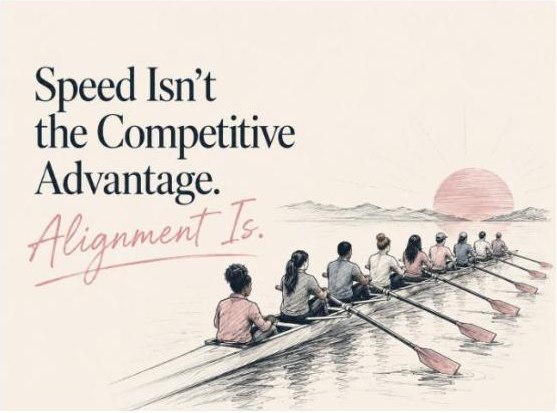
That’s why I don’t believe the next era of competitive advantage belongs to the organizations moving the fastest. It belongs to the organizations moving together.
- Alignment isn’t consensus.
- It isn’t more meetings.
- It isn’t slowing decisions down. It’s creating enough shared clarity that decisions made across different functions still move the organization in the same direction.
AI will continue to compress the time it takes to create. Leadership will become even more important in determining what gets created, why it matters, and how the organization moves together.
The organizations that outperform won’t simply be the fastest. They’ll be the most aligned.
What is your take?
If your organization feels misaligned and you need help. Contact me!